Thursday, March 19, 2020

Species Profile: Ethiopian wolf

Hello again, welcome back to animals under threat. Today, we will be covering one of Africa’s rarest and most endangered carnivore that resides in Ethiopia, Africa. This beautiful canid is under threat from agriculture development and disease. Say hello to the Ethiopian Wolf (Canis simensis).

The Ethiopian wolf is a canid that is characterized by their long-limbed legs and slender body. They have a black bushy tail that can measure up to 40cm in length and have a red/rusty coloured coat with white fur underbelly, chest, throat and muzzle. Females Ethiopian wolves are smaller and paler in colour than their male counterpart (awf.com, 2020).
Canis simensis by Brent Huffman 

Unlike most canid species that feed on a variety of animals, the Ethiopian wolf has evolved to be a specialized feeder of small rodents. Their bodies have evolved a long slender snout, long legs, and well-spaced teeth to extract prey from their burrows. In order to hunt, the wolf explores area’s with rich food and slowly walk up to the burrows to investigate using their hearing (Yihune & Bekele 2014).

Video of young wolf's attempt at hunting by BBC America.

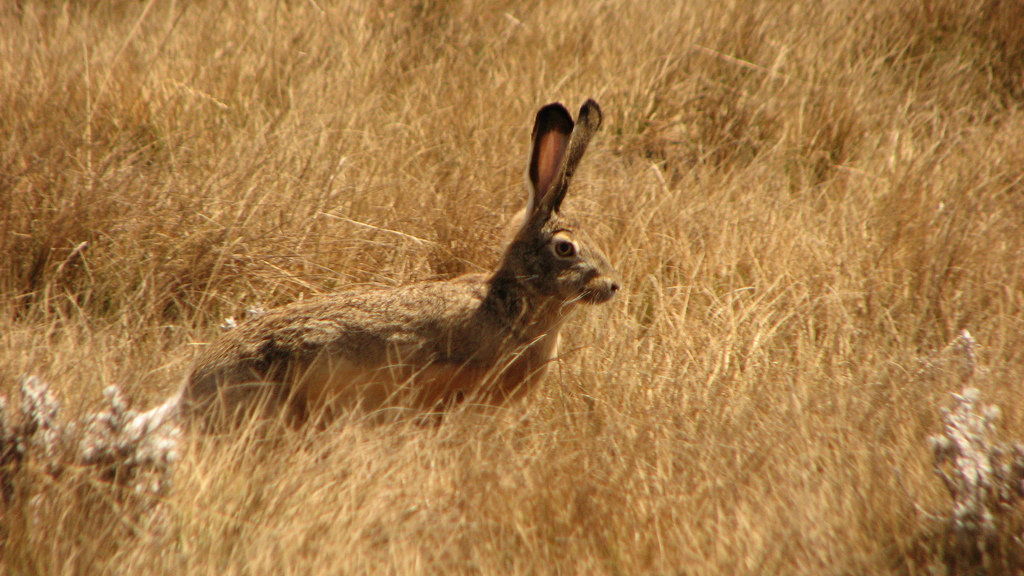
Once the prey has been located, the wolf slowly approaches it which this can take up to an hour or more. If the prey runs, the wolf will run a zigzag pattern to catch any rodents in the area (Yihune & Bekele 2014). Their preferred prey is the big-headed African mole rat, (Tachyoryctes macrocephalus) and Ethiopian highland hare (Lepus starcki) (Sillero-Zubiri, & Gottelli, 1995).

Mole Rat by Charles J Sharp (above) and Hare by unknown (Below)

Ethiopian wolves are family oriented with most packs containing extended family members that help raise the dominant pair pups. The alpha female wolf digs a burrow under a boulder or in a rocky crevice and can give birth to 2-6 pups (iucnredlist.org, 2020). All members of the pack care and protect the pups with younger females helping the dominant female with suckling. Young females leave their parent pack at the age of two and search for another pack. This is called female-biased dispersal which can help prevent inbreeding in packs as related member cannot breed with other relatives (awf.com, 2020)
Canis simensis and pups by Dada Gottelii and Claudio Sillero-Zubiri

The Ethiopian wolf is under threat from increasing agriculture development and disease. Diseases such as rabies and canine distemper from infected domestic dogs has had a negative impact on the wolf’s population as this can lead to death of adults and pups (Marino et al, 2017). Increasing agriculture development has had an impact on the wolf’s prey as the habitat their prey lives in is being destroyed from agriculture (iucnredlist.org, 2020).

Next time, we will be covering a second largest species of shark that feeds on plankton.

References
https://www.awf.org/wildlife-conservation/ethiopian-wolf retrieved 20/03/20

Marino, J., Sillero-Zubiri, C., Deressa, A., Bedin, E., Bitewa, A., Lema, F., Rskay, G., Banyard, A. & Fooks, A.R. 2017, "Rabies and Distemper Outbreaks in Smallest Ethiopian Wolf Population", Emerging infectious diseases, vol. 23, no. 12, pp. 2102-2104.

Yihune, M. & Bekele, A. 2014, "Feeding ecology of the Ethiopian wolf in the Simien Mountains National Park, Ethiopia", African Journal of Ecology, vol. 52, no. 4, pp. 484-490

https://www.iucnredlist.org/species/3748/10051312

Sillero-Zubiri, C. & Gottelli, D. 1995, "Diet and Feeding Behavior of Ethiopian Wolves (Canis simensis)", Journal of Mammalogy, vol. 76, no. 2, pp. 531-541.


picture references
https://www.iucnredlist.org/species/3748/10051312
https://en.wikipedia.org/wiki/Ethiopian_highland_hare
https://en.wikipedia.org/wiki/Big-headed_African_mole-rat   By Charles J Sharp
https://www.iucnredlist.org/species/3748/10051312  Canis simensis and pups by Dada Gottelii and Claudio Sillero-Zubiri
https://www.youtube.com/watch?v=-ZOqPsz1LnE  (video)


Sunday, March 8, 2020

Species Profile: Spoon-billed Sandpiper


Hello again, welcome back to animals under threat. Today, we will be covering a species of bird from the genus Calidris. This species has become critically endangered due to loss of their breeding habitat during winter by coastal development. Say hello to the Spoon-billed Sandpiper (Calidris pygmaea).

The Spoon-billed Sandpiper is a critically endangered migratory shorebird that breeds along coastal tundra in the north-east arctic of Chukotka Autonomous Okrug and northern Kamchatka Kraj, Russia. In non-breeding seasons, this bird migrates to Southern Russia, China, Korea and Japan (Clark et al, 2018).

Spoon-billed Sandpiper is characterized by a unique black spatulate beak. During non-breeding seasons, the feathers of this bird are a mixture of white, black and gray with a lightly gray streaked cap on its head. During breeding seasons, the feathers turn a rich red/brown colour on the head, breast and back. The breast is also covered with black spotting that extends to the belly that is white (Birds.cornell, 2020).

Non-breeding Calidris pygmaea (below) by Zheng Jianping and baby bird (above)by John O’Sullivan

The Spoon-billed Sandpiper requires a very specialized habitat that it needs in order to breeding in. this habitat is made of lagoon spits that contain crowberry-lichen vegetation or dwarf birch and willow sedges with adjacent estuary/mudflats in which the adults that are nesting can use as a feeding ground (BirdLife international, 2017).


Dwarf Birch by unknown.


They mostly feed on moss, small insects and marine vertebrates. Male Spoon-billed Sandpipers preform a courtship dance over their territory in order to attract a mate. When laying eggs, females lay 1-4 eggs on a shallow tundra depression and take turns incubating for 19-23 days before the young hatch. Males will look after the chicks until they fledge 20 days later while the females leave soon as the young hatch. When the young reach fledging age, the males will leave them, and the chicks migrate south after a few weeks (Birds.cornell, 2020).


Spoon-billed Sandpipers are under threat from loss of their breeding habitat and trapping/poisoning. Coastal development has removed the specialized habitat that the birds rely on for breeding and feeding as they require lagoon spits with the vegetation adjacent from mudflats. Trapping and poisoning have also reduced population numbers as the birds are accidentally/purposely caught in nets and also feed on poison bait in the traps (Peng et al, 2017).


Next time, we will be covering a rare wolf that lives in the Ethiopian Highlands.


References

BirdLife International 2017. Calidris pygmaea (amended version of 2017 assessment). The IUCN Red List of Threatened Species 2017: e.T22693452A117520594.


Clark, N.A., Anderson, G.Q.A., Li, J., Syroechkovskiy, E.E., Tomkovich, P.S., Zöckler, C., Lee, R. & Green, R.E. 2018, "First formal estimate of the world population of the Critically Endangered spoon-billed sandpiper Calidris pygmaea", Oryx, vol. 52, no. 1, pp. 137-146.


https://www.birds.cornell.edu/home/spoon-billed-sandpiper-facts/ retrieved 9/03/2020


Peng, H., Anderson, G.Q.A., Chang, Q., Choi, C., Chowdhury, S.U., Clark, N.A., Gan, X., Hearn, R.D., Li, J., Lappo, E.G., Liu, W., Ma, Z., Melville, D.S., Phillips, J.F., Syroechkovskiy, E.E., Tong, M., Wang, S., Zhang, L. & Zockler, C. 2017, "The intertidal wetlands of southern Jiangsu Province, China - globally important for Spoon-billed Sandpipers and other threatened waterbirds, but facing multiple serious threats", Bird Conservation International, vol. 27, no. 3, pp. 305-322.


picture references

https://www.iucnredlist.org/species/22693452/117520594#assessment-information Non-breeding Calidris pygmaea


https://www.theguardian.com/environment/2019/dec/29/wildfowl-wetlands-trust-spoon-billed-sandpiper-conservation (baby bird)


https://en.wikipedia.org/wiki/Betula_nana (drawf birch)


Wednesday, March 4, 2020

Species Profile: Franklin's Bumble Bee


Hello again, welcome back to animals under threat. Today, we will be covering a species of bee that has come under threat from habitat loss and introduction of exotic diseases. Please give a warm welcome to Franklin's Bumble Bee (Bombus franklini).

Franklin’s bumble bee belongs to the genus Bombus which contains over 250 different species of bumble bee. This species of bumble bee can be distinguished by their solid black abdomen and yellow U-shaped on the thorax. Females have black hair on their faces while males have yellow hair on their face. Franklin's Bumble Bee has the most restricted range out of all the bee species and is only found in Southern Oregon to Northern California, USA (BOMBUS SANDERSONI FRANKLIN, 1913).

Female (above) and male (below) Franklin's Bumble Bee by SANDERSON.

As with most species of bees, the Franklin's Bumble Bee lives in large social colonies made up of one queen and her offspring. This species of bee prefers to nest in abandoned rodent burrows, on the ground or in a pile of rocks so long as there is room, shelter, food and resting available.

As this species of bee belongs to the Bombus genus, they have a unique genetic system where unfertilized (haploid) eggs become males that carry a single set of chromosomes while fertilized (diploid) eggs become females that carry two sets of chromosomes. This is called the haplodiploid sex determination system (Endangered and Threatened Wildlife and Plants, 2019). This can lead to inbreeding due to lack of genetic diversity in the colony.
Franklin's bumble bee in flower by Pete Schroeder.

Due to the commercial use of Franklin's Bumble Bee colonies in greenhouse for pollinating of crops as lead to an increase of exotic diseases/pathogens affecting the native population. Some of these diseases are tracheal mites (Locustacarus buchneri) and intestinal protozoa (Crithidia bombi, Nosema bombi) which can transfer to other bees by flowers that an infected bee has fed on or within the colony itself. Loss of habitat due to agricultural reason has also affect the population due to the removal of native flower species which the bees depend on (Kevan, 2008).

Next time, we will be covering a species of bird from the genus Calidris.


References
BOMBUS SANDERSONI FRANKLIN, 1913 SANDERSON BUMBLE BEE 2014.

Endangered and Threatened Wildlife and Plants; Endangered Species Status for Franklin's Bumble Bee (Bombus franklini)2019, , Federal Information & News Dispatch, Inc, Washington.

Kevan, P.G. 2008. Bombus franklini . The IUCN Red List of Threatened Species 2008: e.T135295A4070259.

Picture reference
BOMBUS SANDERSONI FRANKLIN, 1913 SANDERSON BUMBLE BEE 2014. (male and female bee)
https://www.iucnredlist.org/species/135295/4070259 (bee in flower)


Species Profile: Axolotl

Hello again, welcome back to animals under threat. Today, we will be covering a species of salamander nicknamed the “Mexican walking fish”. This species has become critically endangered from pollution damaging their habitat. Please give a warm welcome to the Axolotl (Ambystoma mexicanum).

The Axolotl is a species of salamander that is only found in the lakes in Xochimilco, Central Mexico. They require deep water lake in order to survive in with large amount of aquatic vegetations. This species lives permanently in water and unlike other salamanders, this species does not undergo complete metamorphosis (Luis et al, 2010).

Axolotl can be characterized by their large head, lidless eyes, underdeveloped limbs with long thin digits, long body and three pairs of gill stalks behind the head. Wild Axolotl are a dark brown/tan with olive under belly (Frost et al, 1984). Axolotl also have four pigmentation genes which changes the colour of the Axolotl. These genes are leucistic (pale pink with black eyes), axanthic (grey with black eyes), albino (gold with gold eyes) and melanoid (black) (Dunson & Dunson, 1974).
Melanoid Axolotl by Ian Bride (below) and Albino Axolotl by Henk Wallays (above).
 
Female Axolotl’s become heavy with eggs when it is time to breed while males have an enlarged gland that produces jelly to protect his sperm. Both male and female Axolotls reach breeding maturity at the age of 1 year and can breed up to 8-10 years. Axolotl eggs take about 2 weeks to hatch and young Axolotl have an internal yolk sac that can sustain them for a week. After 2 weeks, the young Axolotl are large enough to feed on crustaceans/shrimp (Gresens, 2004).

The main threat to the Axolotl is pollution of their natural environment. Urbanization and tourism have led to an increased in pollution in the water ways that contains the vegetation that the Axolotl rely on. Pollution has also affected the lake where the Axolotl currently reside in, adding to the risk of extinction due the Axolotl been found nowhere in the world (Luis et al, 2010).

Next time, we will be covering a species of bee that is under threat.

References
Dunson, M.K. & Dunson, M.K. 1974, "Ultrastructure of pigment cells in wild type and color mutants of the Mexican axolotl", Cell and Tissue Research, vol. 151, no. 2, pp. 259-268.

Frost, S.K., Briggs, F. & Malacinski, G.M. 1984, "A color atlas of pigment genes in the Mexican axolotl ( Ambystoma mexicanum)", Differentiation, vol. 26, no. 1, pp. 182-188.

Gresens, J. 2004, "An Introduction to the Mexican Axolotl ( Ambystoma mexicanum )", Lab Animal, vol. 33, no. 9, pp. 41-47.

Luis Zambrano, Paola Mosig Reidl, Jeanne McKay, Richard Griffiths, Brad Shaffer, Oscar Flores-Villela, Gabriela Parra-Olea, David Wake 2010. Ambystoma mexicanum . The IUCN Red List of Threatened Species 2010: e.T1095A3229615.

Picture references

Sunday, February 2, 2020

Species Profile: Leaf-scaled Sea Snake

Hello again, welcome back to animals under threat. Today, we will be covering a species of sea snake that has become critically endangered due to climate change. Please give a warm welcome to the Leaf-scaled Sea Snake (Aipysurus foliosquama).

The Leaf-scaled Sea Snake belongs to the Elapidae family which is the family for venomous snakes such as Cobras, Kraits etc. This snake species is characterized by their reddish brown/purplish dorsal surface with pale cross-bands. The head of the snake has large scales which are symmetrical and large overlapping scales which covers the body giving the scales the appearance of leaves. Leaf-scaled Sea Snakes prefer to live in swallow waters and coral reefs and can live groups or are solitary (Environment.gov, 2020).

Picture of Leaf-scaled Sea Snake by Harold Cogger.

The diet of the Leaf-scaled Sea Snake is currently unknown as many scientists continue to debate on the theory that it may eat fish that live on the reef or other sea snakes (theconversation.com, 2020). There are currently no publish studies about the reproduction rate or mating system of this species making difficult to estimate the population size (animaldiversity, 2020).

The Leaf-scaled Sea Snake is under threat due to climate change and its impact on the snake’s habitat. Increasing temperatures has led to coral bleaching which affect the snake’s ability to hide from predators and prey leading to a decrease in the population from over predation and starvation although this is still been debated by scientists (Lukoschek & Guinea, 2010).

Next time, we will be covering a species of salamander nicknamed the “Mexican walking fish”.


References
https://animaldiversity.org/accounts/Aipysurus_foliosquama/ retrieved 3/02/20

http://www.environment.gov.au/cgi-bin/sprat/public/publicspecies.pl?taxon_id=1118 retrieved 3/02/20

Lukoschek, V. & Guinea, M. 2010. Aipysurus foliosquama . The IUCN Red List of Threatened Species 2010: e.T176714A7288783.

http://theconversation.com/australian-endangered-species-sea-snakes-12054 retrieved 3/02/20

Picture references
http://www.environment.gov.au/cgi-bin/sprat/public/publicspecies.pl?taxon_id=1118 retrieved 3/02/20

Friday, December 20, 2019

Species profile: Polar bear


Hello again, welcome back to animals under threat. Today, we will be covering the largest carnivore in the arctic circle and is considered to be the largest bear species to be alive currently. This species of bear is under threat from loss of sea ice due to global warming, pollution, and human interaction. Give a warm welcome to the Polar bear (Ursus maritimus).

Polar bears are characterized by their white fur, long neck, small head, rounded ears and short tail. Male polar bears are larger than the females as they can weigh up to 410-720 kg or 900-1,600 pounds. Sometimes nicknamed the sea/ice bear, polar bears live throughout the arctic region and travel across ice floes to search for seals. It has not natural predators or rival species and has no fear of humans (Britannica.com, 2019).


Polar bears have adapted to their arctic home with unique adaptions. They have a thick coat of fur which covers a layer of fat that keeps the bear warm. The bear’s fur also grows over their paws which helps protect them against cold surfaces and help the bear’s grip on the ice. Polar bears have black skin under their white fur which absorb the sun’s rays to help keep the bear warm (Nationalgeographic.com, 2019). Polar bears can swim up to a pace of six miles per hour by paddling their front legs and using their back legs as a rudder (Worldwildlife.org, 2019).

polar bear's fur and skin by Jon Aars / Norwegian Polar Institute / WWF-Canon

Female polar bear reaches mature age between 4-5 years old and can start breeding. Pregnant polar bears enter a den that is usually located in a snow drift or slopes in order to give birth. Usually twin cubs are born although there have been cases where only one cub is born or triplets. The cubs feed on their mother milk while the mother fast until she is ready to open the den. They stay near the den as the cubs learn to walk and play while the mother feeds on the vegetation that is around the den. The mother will then lead her cubs out to the sea ice to hunt seals as the cubs observe their mother’s hunting. There has been rare case of cubs that have been adopted by other female polar bears after they have been abandoned. The mother will look after her cubs for 2 and half years leaving them to survive on their own (Wiig et al, 2015).
                                                                         polar and cub by AWeith

As polar bear has no fear of humans, they enter human settlements to find food and exploring the area. This has led to conflict between humans and polar bears as polar bears are shot and killed by humans defending their homes and food (Wilder et al, 2017). Due to the increase in global warming, the sea ice that the bears depend is decreasing which makes it harder from the bears to hunt and have to swim longer leading to drowning. With pollution from human settlement such as plastic bags been found in polar bear stomach leading to death of the animal due to eating the plastic (Regehr et al, 2016).


Next time, we will be covering a species of sea snake that has an unusual name.


References

https://www.britannica.com/animal/polar-bear retrieved 21/12/19

https://www.nationalgeographic.com/animals/mammals/p/polar-bear/ retrieved 21/12/19


Regehr, E.V., Laidre, K.L., Akçakaya, H.R., Amstrup, S.C., Atwood, T.C., Lunn, N.J., Obbard, M., Stern, H., Thiemann, G.W. & Wiig, Ø. 2016, "Conservation status of polar bears (Ursus maritimus) in relation to projected sea-ice declines", Biology letters, vol. 12, no. 12, pp. 20160556.


https://www.worldwildlife.org/species/polar-bear retrieved 21/12/19


Wiig, Ø., Amstrup, S., Atwood, T., Laidre, K., Lunn, N., Obbard, M., Regehr, E. & Thiemann, G. 2015. Ursus maritimus . The IUCN Red List of Threatened Species 2015


Wilder, J.M., Vongraven, D., Atwood, T., Hansen, B., Jessen, A., Kochnev, A., York, G., Vallender, R., Hedman, D. & Gibbons, M. 2017, "Polar bear attacks on humans: Implications of a changing climate", Wildlife Society Bulletin, vol. 41, no. 3, pp. 537-547.


picture references

polar bear skin by Jon Aars / Norwegian Polar Institute / WWF-Canon

polar and cub by By AWeith


Species profile: Blue whale


Hello again, welcome back to animals under threat. Today, we will be covering the largest marine mammal currently alive today. Its current geographical range covers all the oceans in the world and is under threat from whaling. Please welcome the Blue Whale (Balaenoptera musculus).


Growing over 30 meters in length, the blue whale is currently the largest marine mammal alive today. Feeding on its favourite food, which is krill, the blue whale can weigh up to 200 tonnes (Britannica.com, 2019). Blue whales belong to the baleen whale family which means they have fringed plates that contains finger-like material called baleen. The whale swallows a mouthful of water and its tongue pushes the water through the plates leaving the krill behind (nationalgeographic, 2019).

Unlike other whale species that live in pods, blue whale prefers to live alone or in pairs. A blue whales call is a low frequency whistle that reaches 188 decibels which is louder than a jet engine. This call is useful for finding a mate in the ocean (wwf.org.au, 2019). Female blue whales carry a calf for a year before it is born. The calf can weigh up to 3 tonnes and 25 feet long when born and feeds on its mother’s milk, gaining 200 pounds every day for its first year (Worldwildlife.org, 2019).


Blue whales are under threat from whaling, entanglement of nets, pollution and global warming. Baby and juvenile whales are at risk of drowning due to been caught in nets as they are unable to free themselves. Adult whales are at risk from whaling as they are hunted for their meat due to their size. Pollution from plastics has led to the whales dying due to the plastics they ingested cannot be removed. Global warming has increased the temperatures in the water which affects the whale’s food supply as the krill are dying due to the temperature (Clapham et al, 1999).

Next time, we will be covering the largest carnivore in the arctic circle and is considered to be the largest bear species to be alive currently.  


References
Clapham, P.J., Young, S.B. & Brownell, R.L. 1999, "Baleen whales: conservation issues and the status of the most endangered populations", Mammal Review, vol. 29, no. 1, pp. 37-62.

Cooke, J.G. 2018. Balaenoptera musculus . The IUCN Red List of Threatened Species 2018: e.T2477A50226195. http://dx.doi.org/10.2305/IUCN.UK.2018-2.RLTS.T2477A50226195.en.

https://www.nationalgeographic.com/animals/mammals/b/blue-whale/ retrieved 11/12/19
https://www.britannica.com/animal/blue-whale retrieved 16/12/19
https://www.worldwildlife.org/species/blue-whale retrieved 16/12/19
https://www.wwf.org.au/what-we-do/species/blue-whale#gs.mmndbc retrieved by 16/12/19

Picture references
https://en.wikipedia.org/wiki/Blue_whale
https://www.britannica.com/animal/blue-whale
https://au.whales.org/whales-dolphins/species-guide/blue-whale/